Model context protocol (MCP)
The Model context protocol (aka MCP) is a way to provide tools and context to the LLM. From the MCP docs:
MCP is an open protocol that standardizes how applications provide context to LLMs. Think of MCP like a USB-C port for AI applications. Just as USB-C provides a standardized way to connect your devices to various peripherals and accessories, MCP provides a standardized way to connect AI models to different data sources and tools.
MCP enables you to use a wide range of MCP servers to provide tools to your Agents.
MCP servers
Currently, the MCP spec defines two kinds of servers, based on the transport mechanism they use:
- stdio servers run as a subprocess of your application. You can think of them as running "locally".
- HTTP over SSE servers run remotely. You connect to them via a URL.
You can use the MCPServerStdio and MCPServerSse classes to connect to these servers.
For example, this is how you'd use the official MCP filesystem server.
async with MCPServerStdio(
    params={
        "command": "npx",
        "args": ["-y", "@modelcontextprotocol/server-filesystem", samples_dir],
    }
) as server:
    tools = await server.list_tools()
Using MCP servers
MCP servers can be added to agents. The runner collects tools from each server (via list_tools()) when the agent runs, so the model can call them; each invocation uses the server's call_tool().
from cai.sdk.agents import Agent

# mcp_server_1 and mcp_server_2 are connected MCPServerStdio / MCPServerSse instances.
cybersecurity_lead = Agent(
    name="Cybersecurity Lead Agent",
    instructions="Use the tools to solve the task.",
    mcp_servers=[mcp_server_1, mcp_server_2],
)
Caching
Every time an Agent runs, it calls list_tools() on the MCP server. This can be a latency hit, especially if the server is a remote server. To automatically cache the list of tools, you can pass cache_tools_list=True to both MCPServerStdio and MCPServerSse. You should only do this if you're certain the tool list will not change.
If you want to invalidate the cache, you can call invalidate_tools_cache() on the servers.
End-to-end examples
See the examples/mcp/ directory in the CAI repository for runnable scripts (stdio and SSE patterns).
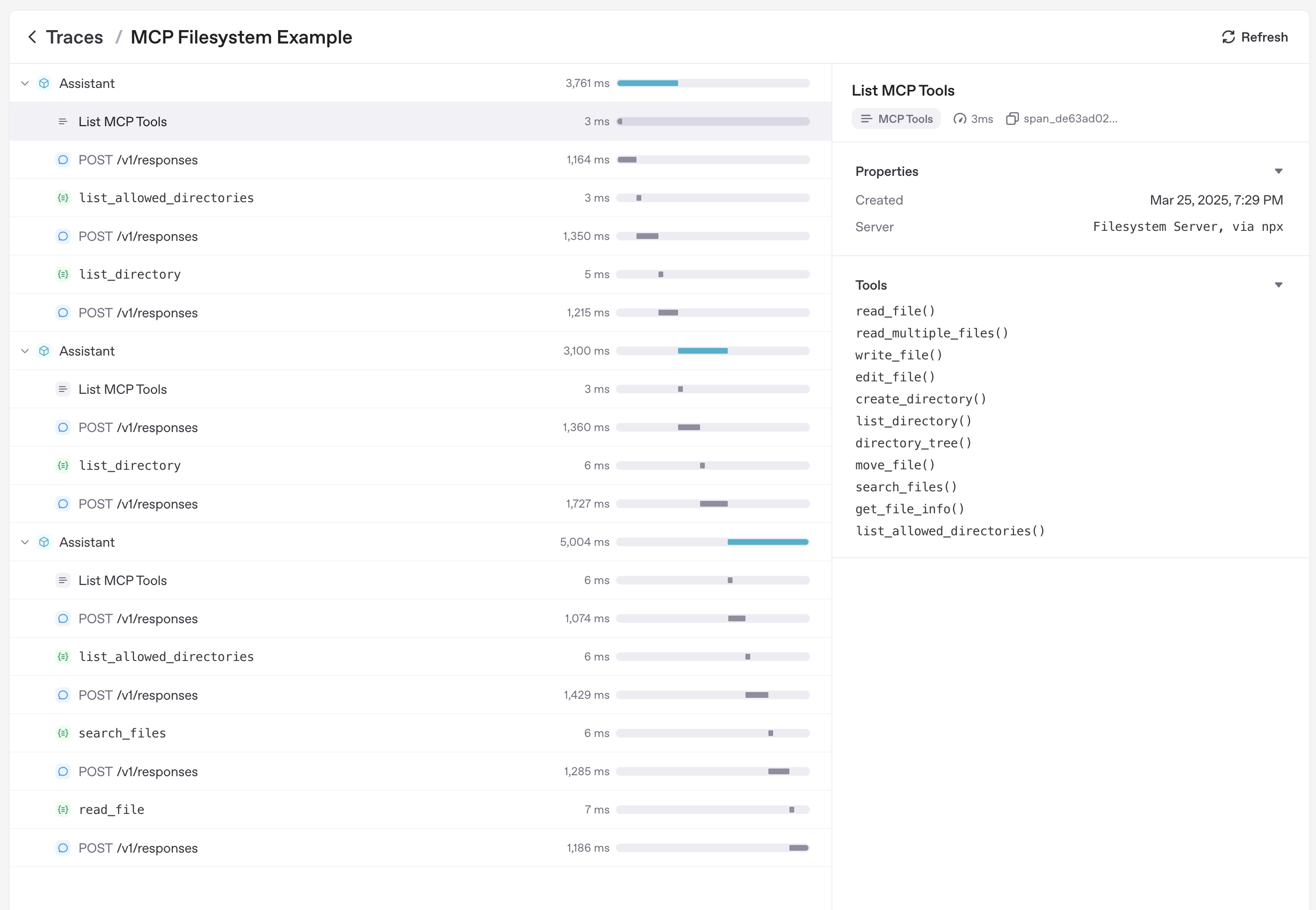
Tracing
Tracing automatically captures MCP operations, including:
- Calls to the MCP server to list tools
- MCP-related info on function calls